
I like coaster brakes on city bikes and I am very comfortable using them. My preferred transportation bike set-up is to have a coaster brake in the rear and a hand-operated hub or rim brake in the front. Typically I use just the coaster brake most of the time, employing the hand-operated front brake to keep the bike still when coming to a complete stop or to supplement the coaster when braking at high speeds. The role my front brake plays in these scenarios is small, but crucial - which I realise more than ever when riding the coaster brake-only Sogreni I picked up last week.

Slowing down on the coaster brake-only bike is exactly the same as on my own bikes - I'd be using the coaster brake alone for this anyhow. But coming to a complete stop and keeping the bike still when stopped is trickier without a front brake. The main thing I've had to learn is not to ease up on the coaster brake when stopping as I normally do, but to continue pushing back on the pedal with the right foot firmly even as I put the left toe down at a stop. If I ease up the pressure on the right pedal, the bike will keep rolling forward. Coming to a complete stop on a downhill is trickier still, because the bike really, really wants to roll forward and my right foot has to push back with all the force I can muster. Squeezing a front lever is much easier in this context.

Stop-and-go traffic presents its own challenge, because a coaster brake can only be engaged effectively from certain crank positions. There is also the transition from having the right crank in the optimal braking position (previous 2 pictures) to having it in the starting position. To transition to the starting position from the braking position, I quickly hook my right foot under the pedal and move it forward as I push off to get started. But once the pedal is in the starting position, what if I then have to immediately stop again? Inching forward in traffic is tricky, because it is difficult to keep the pedals in a position where I can both stop and get the bike started again with equal immediacy.
Finally, there is the question of speed. When going over 13mph or so, I find that I cannot brake as well as I'd like with just the coaster brake alone. The coaster brake is enough to slow down, but for an emergency stop at that speed I need a front brake to supplement.
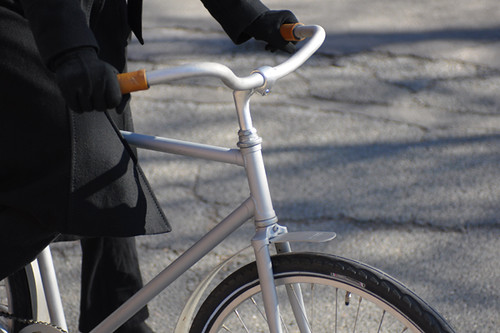
Riding a coaster brake-only bike is certainly possible, but in a city like Boston I feel that it is safer to also have a front hand-operated brake. The motivation behind bikes without front brakes today seems to be the "clean handlebars" look, which has always baffled me. I fail to see what is so gorgeous about not having a brake lever on my handlebars, when that brake performs an obvious and necessary function.


 "But, Mom! Warm, clean towels make such a nice bed."

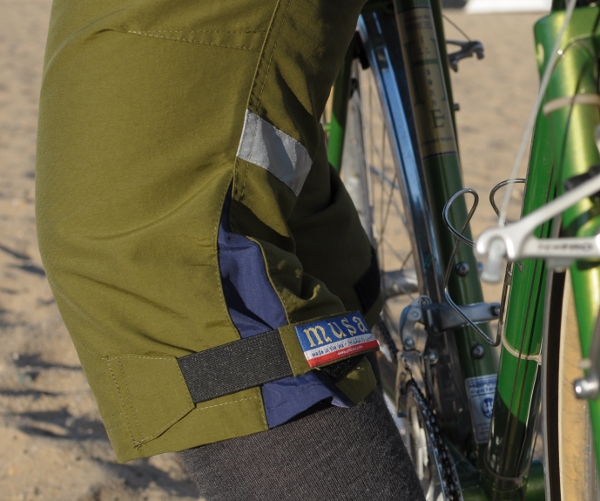 Musa is a Rivendell house brand that stands for "made in USA." Under this label, Rivendell produces a line of clothing and accessories, including theknickers and pantsthat are designed specifically for cycling, but are described as being wearable "anywhere when formal wear isn't called for." The Co-Habitant ordered both the knickers and the long pants over the summer, because he was wearing out all his regular pants on long rides, and he thought these would be more durable. He immediately loved them and kept recommending them to me - until I finally bought a pair of knickers myself a couple of months later. Our impressions of this product are somewhat different, and put together they will hopefully be informative for both genders.
 Made of lightweight, breathable, and durable nylon, the Musa knickers work well for cycling, because they feature a roomy gusset in the crotch area, adjustable-width cuffs with velcro straps, andreflective strips.
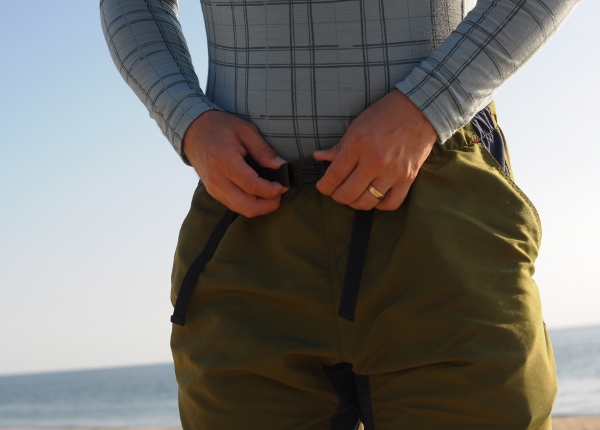 The adjustable waist closes via one of those nylon belts and plastic buckles you see on hiking pants.
 The pockets are deep and cut in a way that stuff doesn't spill out of them while cycling - a useful feature for those who like to keep small items on their person while on the bike.
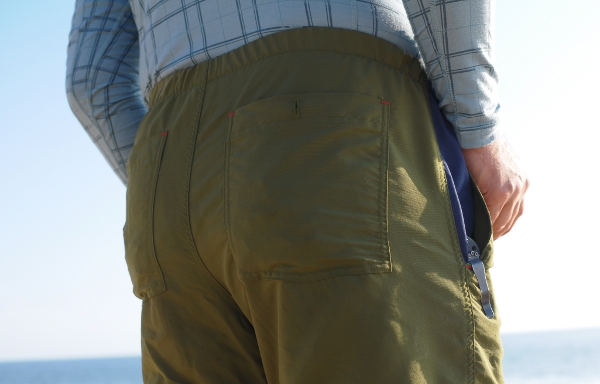 The Co-Habitant normally wears pants with a 34" waist, and the XLMusasfit him well. They are relaxed, but with a tailored look to them.The cut is flattering to the male body.
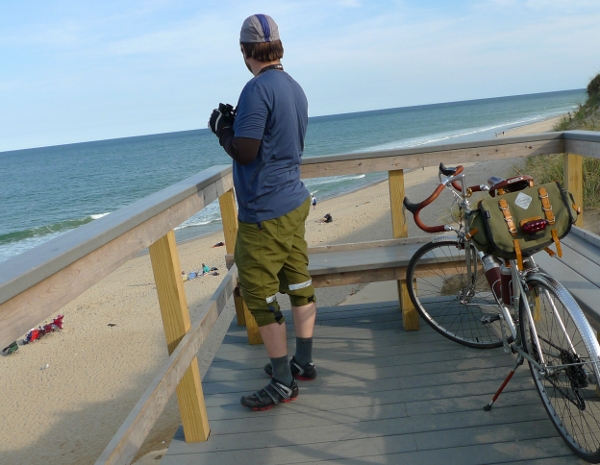 The pants and knickers are currently available in olive, gray, black and blue. The Co-Habitant has the olive knickers (pictured) and the gray long pants. The knickers he wore mostly over the Summer and early Fall; the pants he continues to wear now, including off the bike. His feedback is that hisMusas are extremely comfortable and useful. Not only does the seamless gusset protect from chafing during long trips, but the pants regulate temperature well in both hot and cold weather, and are a lot more durable than the trousers he wears off the bike (one problem with cycling long distance in regular clothing, is that the clothing can get ruined from rubbing against the saddle and from sweat). For those men who do not want to wear tight, padded cycling shorts, but want something cycling-specific that looks decent off the bike, these are a good option. I do not quite agree with Rivendell's description of them looking like "normal" pants. They are definitely quirky. But I find this particular quirkiness attractive.
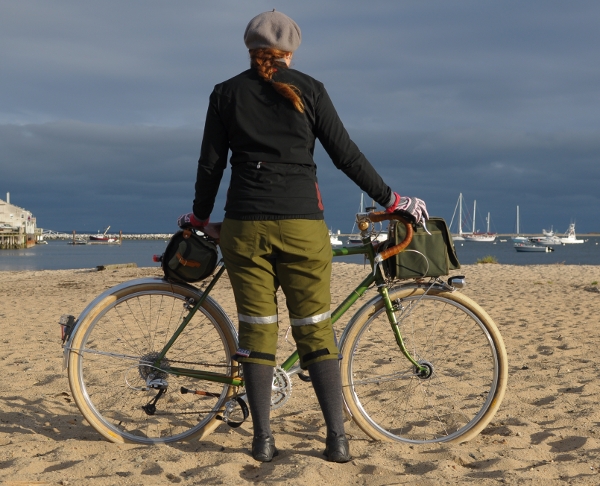 Moving on to my own experience with the Musa knickers (and in case you are wondering - no, we do not wear them at the same time!), my main reason for buying them was the gusset. I cannot ride a roadbike for more than 20 minutes while wearing anything with seams along the crotch, and finding pants without seams in that region is not easy. So seeing how happy the Co-Habitant was with his Musas, I finally ordered a pair for myself. Rivendell describes these knickers as unisex and has a size chart for women. Going by the waist measurements on the chart, I initially ordered an XS. However, I could not pull them on over my hips, so I exchanged them for a Small. The Small went on over my hips fine, but fit me overly loosely petty much everywhere else.
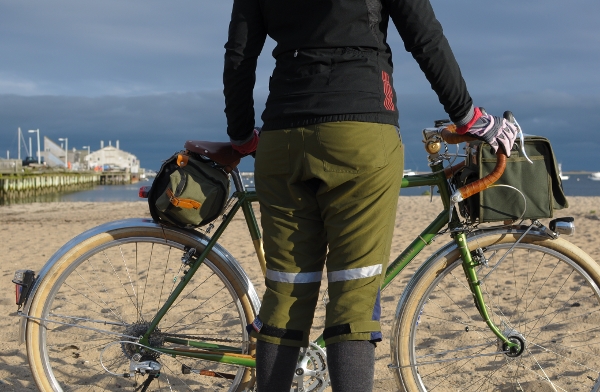 Sometimes a loose fit can be flattering, but with the Musa knickers luck was not on my side. The sagginess in the butt distorts the shape of my body in a way that just doesn't look good, and extra material bunches up around my inner thighs.
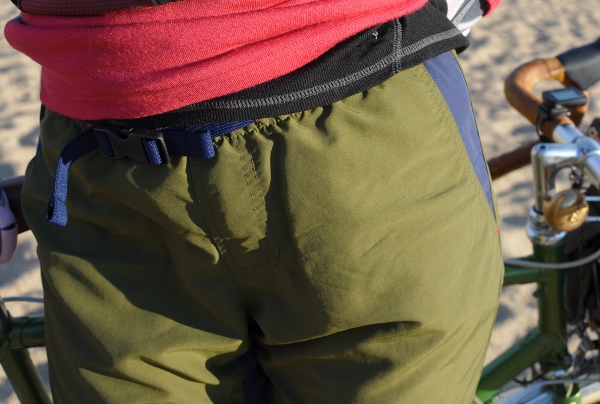 The knickers are also overly loose in the front. It is as if the fabric won't lie against my body right - bunching up in all the wrong places. This leads me to conclude that the pants were simply not tailored with a female waist-to-hip ratio in mind. While I am not the curviest woman in the world, I do have a narrow waist and comparatively wide hips - a combination that makes it difficult to get the sizing right.
 But fit and sizing issues aside, the Musa knickers do have a number of features I find useful. The gusset is huge and there is not a single seam between me and any part of the saddle, which is excellent. The nylon material really is very light and breathable, as well as wind-resistant, mildly water resistant and fast-drying. The fabric does not pill or degrade after prolonged contact with the saddle - and having worn through several pairs of leggings and shorts over the past year, such durability is welcome. The pockets are staggeringly deep - though the feature is wasted on me, as I prefer to cycle without too much stuff in my pockets. The expandable width cuffs with velcro closure are clever, if a bit finicky (I had to redo mine a few times to get them to feel right). As other owners of these have noted, the pants were shiny and slippery in the beginning, but this went away after a few long rides.


 From where we were sitting, we could visibly see the Dolomites, its snow-capped mountains. I think there is snow there throughout the year. The English folks sitting near us told us—you could not ask for any better table in this restaurant. Hmm, I think they desperately wanted to switch tables with us, haha.


 Momma zipping along
 Along the lake
 Early morning sun streaming through the forest. Most of the trees near the road were not affected by the fire but there was a smoky haze and acrid smell that filled the air.
 This section was particularly bad because the smoke was “enhanced” by fog from a nearby lake.
 Less than an hour later, I was through the burned-out area and back in sunshine.
 The route from Skagway – north, then east, and finally south.

